
Blog
Soft or Spongy Bathroom Floor Near the Toilet: What It Means
A soft or spongy floor near the toilet usually means water has been getting past the toilet's seal or flange and soaking the wood subfloor under your flooring. Softened subfloor won't firm back up by drying, and the damage is often bigger than the soft spot. Check it gently, then have the toilet pulled and the floor opened.
Good Life Home Co. finds the leak and rebuilds the floor with one in-house team in Fort Collins, Windsor, and Loveland. Call or text 970-610-6200.
Written with Luke Buelow, Colorado master plumber, Good Life Home Co.
What a soft floor near the toilet is telling you
A soft floor around the toilet is a subfloor problem, not a flooring problem. The tile, vinyl, or luxury vinyl plank is only riding on the wood panel underneath. When that panel has taken on water, it swells, separates, or rots, and the finished floor starts to give under your foot.
The toilet is the usual spot because the wax seal and the flange sit right on the subfloor. A leak there drains down, not out. You can have a spongy floor near the toilet and never see a puddle. Soft spots in the bathroom floor farther from the bowl often mean the water has already traveled along the panel.
It does not fix itself. Wet or rotted decking does not firm back up once it dries. It has to be found, the source stopped, and the damaged section replaced. We do not use scare timelines for how fast that happens. What we can say is that a soft spot is already a reason to look, not a reason to wait and hope.
If the give is near the toilet, the repair belongs with toilet leak floor damage repair. That page is the scope: the leak, the floor, and the toilet, with one in-house team.
Where the water usually comes from
In a short version, the usual sources are a failed wax seal or a damaged flange at the base. Sometimes it is a supply line or a tank connection. Sometimes the tank sweats and the water sits against the base long enough to matter. Any of those can soak the wood without a visible flood.
If the toilet also rocks, the soft floor and the movement often go together. Movement breaks the seal a little more with each use. See why a toilet rocks and whether the floor is rotten. This post stays with what the softness means. That post stays with bolts, shims, and the flange.
How deep the damage can go: layer by layer
Most pages stop at "the subfloor." The useful question is how far past that soft spot the water may have gone. You cannot know the edge from above. You can know the layers, and you can know that the repair area is set by sound wood and framing, not by the stain you can see.
1. Finished floor
Tile, vinyl, or luxury vinyl plank. Stains and lifting are a clue.
2. Underlayment
A thin layer, if the floor has one. It can swell and crumble.
3. Subfloor
Usually plywood or OSB. Some older homes have particleboard. This is the layer that goes soft.
4. Floor joists
The framing under the panel. Checked once the subfloor is open.
5. The room below
A ceiling stain, or dark wood in a crawlspace or unfinished basement.
- Finished floor. Tile, vinyl, or LVP can show a stained ring, lifted seams, bubbling vinyl, cracked tile, or dark grout near the base. That is cosmetic by itself, and it is also a clue that water has been under the surface. Lifted vinyl plank is covered in water under LVP flooring.
- Underlayment, if the floor has one. This is a thin layer between the finish and the structural panel. It can swell and crumble while the room still looks mostly fine.
- Subfloor. Most bathroom subfloors are wood panels, plywood or OSB. Some older homes have particleboard, which loses strength quickly once it is wet. This is what most soft floors are. A soft floor around the toilet is this layer giving way under the finish.
- Floor joists. If water ran long enough, the tops of the joists near the drain can soften too. You cannot tell that from above. Joists get checked once the subfloor is open. If they are damaged, they are repaired before new subfloor goes down. That floor joist repair stays with the same team. This post does not walk through how a joist is sistered or replaced. The service page owns that scope.
- The room or crawlspace below. A stain on the ceiling under an upstairs bathroom, or dark wood seen from a crawlspace or unfinished basement, means water went all the way through. See what a yellow or brown stain on the ceiling under a bathroom means.
Water spreads along the panel and into seams, so the soft spot you can feel is usually smaller than the damaged area. The cut is made back to sound wood and sound framing. That is often bigger than the spot, and it is not automatically the whole room.
What the size and pattern can suggest (not a diagnosis)
A soft ring right at the base points toward the seal and flange. Softness that spreads across a wider area, or across the room, suggests longer exposure or an older, weaker panel. A dip you can see, or a bounce that reaches well away from the toilet, is a sign it may have reached framing.
We do not use inch cutoffs or square-foot rules. Sources do not agree on them, and a number would pretend the floor has already been opened. The bigger and deeper the give, the more likely it goes past the subfloor. Only opening the floor confirms it.
Check it yourself: safe steps
You do not need tools, and you should not take anything apart. These checks only help you describe what you are seeing.
- Press, do not jump. Stand beside the toilet and shift your weight onto the area around the base: front, both sides, and behind if you can reach. Note where it gives. Do not jump or bounce on it.
- Look at the floor covering. Lifted or bubbling vinyl, cracked or loose tile, dark grout, or a stained ring around the base.
- Check the toilet. Gently push the bowl side to side and front to back with your hands. If it moves, read why a toilet rocks and whether the floor is rotten.
- Dry and watch. Wipe the base and the floor dry, flush, and look for water at the base over the next few minutes. Water that shows up right after a flush points to the base seal.
- Look below if it is easy. On the ceiling under an upstairs bathroom, look for a stain, bubbling paint, or a sag. In a crawlspace or unfinished basement, look only from the access point with a flashlight. Do not crawl into a tight or wet space.
- Take photos. The floor around the base, the toilet base, any stains, and the ceiling below. Photos help us see it before we come out.
If the floor gives noticeably or the toilet moves, use another bathroom if you have one and shut off the toilet's water until it is checked. Turn the supply valve behind the toilet clockwise if you can do that easily. We do not claim the floor will collapse. We do say a floor that is already giving is not a floor to keep testing.
Signs it is time to stop checking and call
Stop and call when any of these show up. Do not keep probing a floor that is already telling you it is weak.
- The floor dips, cracks, or visibly sags when you shift your weight.
- The softness spreads beyond the toilet.
- The toilet rocks.
- The ceiling below is stained, bulging, or dripping, or you can see dark or wet wood below.
- A sewer smell comes and goes. See when a toilet smells like sewage.
- Water appears at the base after you flush. Stop using that toilet and shut the supply valve if you can.
- Baseboard or grout is discolored and you want it looked at. Have discoloration checked. Do not try to clean damaged material out from under the floor yourself.
Also skip the fixes that hide the problem. Do not caulk around the base to "seal" it. Caulk can hide an active leak. Do not keep stacking weight on a soft area. Do not pull up flooring before someone has looked.
Call or text 970-610-6200 when you are ready for that look. We book it as a plumbing visit.
What fixing a soft floor involves
The full sequence lives on the service page. The short version is this: stop the leak, pull the toilet, open the floor back to sound material, check the joists and repair them if needed, repair or replace the flange, install new subfloor, put back flooring, trim, and paint, and set the toilet with a new seal.
The flange and the floor get done together because a new seal needs a solid flange on solid subfloor, at the right height for the finished floor. A flange that sits too low or too high for the new floor will not hold a seal, and the soft spot comes back as a rocking toilet.
We look first and agree on the price before work starts. If something different turns up once the floor is open, we stop and talk first. That is the No Change Order Guarantee. There is no price range on this page, and no promise of how long the repair takes. The first look and quote is usually within a couple of days.
See how we handle toilet leak floor damage repair.
Why one team matters for this job
Most people end up with a plumber for the leak, then someone else for the floor, then a painter. The schedules do not line up, and the leak can get missed while the new floor is already on order. Good Life Home Co. keeps plumbing and handyman work under one roof. The same in-house team handles the flange, subfloor, joists, flooring, trim, paint, drywall, and the toilet.
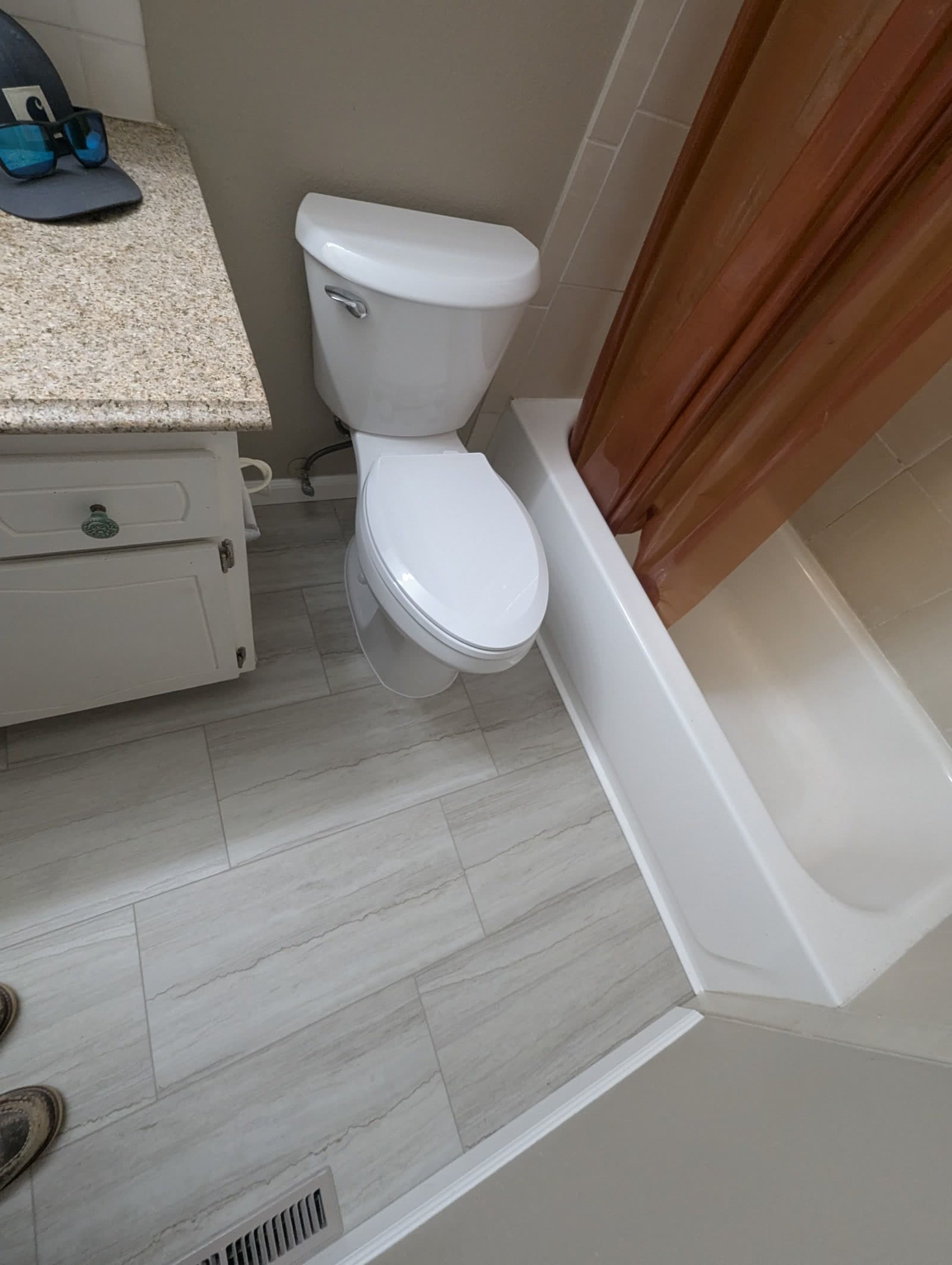
A Loveland homeowner had a leaking toilet and wanted to understand the likely extent of the damage and agree on a repair plan before the floor came up. On a diagnostic visit, Luke walked through the leak, the water damage, and the options before any work started. When the floor was opened, the team removed multiple layers of old tile, rebuilt the floor, restored the toilet, and painted the vent grate to match. That is the question this page is for: how far it goes, answered by opening the floor, not by guessing from the soft spot.
Read the Loveland case study. Work is backed by a 3 Year Workmanship Guarantee. If our workmanship fails within three years, we come back and make it right. Materials follow manufacturer coverage. Readers who want the published rating can use the same figure shown on the site: 5.0 from 63 Google reviews. One of those reviews, from Eric, says: "He clearly explained the process, provided options, answered questions and the results were excellent."
The owner is a Colorado master plumber. The company was founded in 2021. Financing is available. Ask when you call or text. We do not list terms or rates.
Frequently asked questions
Why is my bathroom floor soft near the toilet?
Usually because water from the toilet's wax seal, flange, or supply line has soaked into the wood subfloor under the flooring. The leak often runs down instead of out, so there may be no puddle. The finished floor is only telling you what the panel underneath is doing.
Is a soft bathroom floor dangerous?
It is a sign the floor is weaker than it should be, and it will not improve on its own. If it gives noticeably or the toilet moves, limit use, shut off the toilet's water, and have it checked. Use another bathroom if you have one.
Can a soft spot in the bathroom floor dry out and firm back up?
No. Swollen or rotted subfloor does not regain its strength. It has to be opened, the source fixed, and the damaged section replaced. Drying the room does not put the panel back the way it was.
How do I know if the damage reached the floor joists?
You usually cannot tell from above. A visible dip, a wide soft area, or stained wood seen from below suggests it might have. Joists are checked once the subfloor is opened, and repaired if needed, as part of toilet leak floor damage repair.
Do I need to replace the whole bathroom floor?
Not always. The damaged subfloor is cut back to sound wood and framing, which is often bigger than the soft spot but not always the whole room. The finished flooring in that area has to come up and go back. We do not quote a size or a price until we have looked.
Who fixes a soft floor around a toilet, a plumber or a contractor?
Often it is both: the leak is plumbing, and the floor is carpentry. Good Life Home Co. does both with one in-house team, from the flange to the subfloor, joists, flooring, and toilet. You do not have to line up two contractors for this job.
Does flooring go under the toilet?
Typically the finished floor runs under the toilet, and the flange should sit on top of or even with the finished floor so the seal compresses properly. When we rebuild a floor, the flange is set at the right height for the new flooring.